| Pregnancy, Pediatrics
and HIV Infection: Guidelines for Your Practice Page 8 |
|
| Short-Course Therapy
|
|
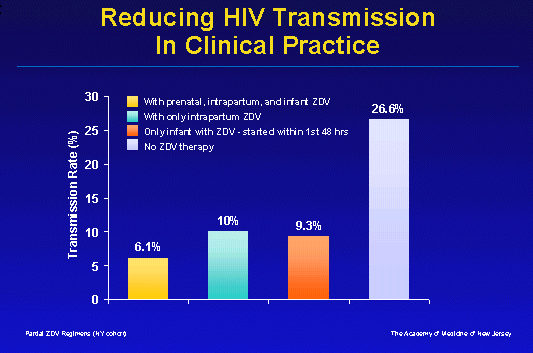
| Short-course therapy may be provided to women in labor whose HIV status is unknown. Wade et al reported the highest transmission rate in women who did not use ZDV (26.6%).7 Short course AZT either intrapartum and in the neonate or only to the neonate was associated with decreased transmission when compared with no treatment at all, 10% and 9.3% respectively. The study concluded that short-course therapy markedly decreased perinatal HIV transmission, whether therapy was started intrapartum or within the first 48 hours. | |
 Wade NA, Birkhead GS, Warren BL, et al. Abbreviated regimens of zidovudine prophylaxis and perinatal transmission of the human immunodeficiency virus. N Engl J Med. 1998. 339:1409-1414. |
|
| Three international studies have shown the efficacy and safety of short course antiretroviral therapy as an alternative to the PACTG 076 regimen. A study conducted in Thailand in 1999 showed a 50% reduction in perinatal HIV transmission when 300 mg bid of ZDV was taken from 36 weeks gestation and every 3 hours during labor.8 Results of the PETRA trial revealed a 38% reduction in perinatal HIV transmission when antiretroviral therapy was provided from 36 weeks gestation.9 In Uganda, Guay et al found a 50% reduction in transmission when nevirapine was administered to women during labor and to infants 48 to 72 hours after birth. | |
|
|
|
|